In 2024 alone, regulators logged 721 large healthcare data breaches affecting over 185 million records, which shows how exposed protected health information linked to biospecimens has become in the United States.
Biobanks that manage tissue blocks, slides, and associated clinical data now need HIPAA-compliant offsite storage that protects both the physical specimens and the identifiable information that follows each biosample through its entire lifecycle.
Key Takeaways
| Question | Answer |
|---|---|
| What is HIPAA-compliant offsite storage for biobanks? | A high-security, off-premises archive that stores biospecimens and their associated PHI under strict access controls, tracking, and documented chain of custody. |
| How does offsite storage support CAP and HIPAA compliance? | By combining controlled environments, validated tracking, and retention-lifecycle controls comparable to integrated records management services used for regulated documents. |
| Can biobanks use digital access while storing specimens offsite? | Yes, scan-on-demand and digital portals, similar to secure document scanning services, provide fast access while specimens remain in secure archives. |
| What role does chain of custody play in biobank storage? | Every movement of a sample, from the lab to offsite storage and back, must be logged and auditable, much like HIPAA-focused secure document storage practices. |
| How should biobanks handle end-of-life specimens and records? | Through policy-driven, certified destruction modeled on secure shredding services, with full documentation and adherence to retention schedules. |
| Who can help assess current storage risks? | Biobanks can request a structured review similar to a records management audit to identify compliance gaps and workflow issues. |
1. Why HIPAA-Compliant Offsite Storage Now Defines Biobank Risk Management
Biobanks in the United States now sit at the intersection of clinical care, research, and data privacy, with tissue specimens tightly coupled to PHI across decades.
In 2023, over 133 million healthcare records were exposed in large breaches, which means that the data connected to biospecimens is now a primary target for attackers rather than a peripheral risk.
HIPAA treats identifiable health information linked to biospecimens as protected, regardless of whether it is stored in physical files, digital databases, or hybrid tracking systems.
As biobank operations scale in 2026, physical storage alone is no longer sufficient, and facilities must match environmental control with rigorous privacy and security controls across all storage tiers.
A HIPAA-compliant offsite facility provides physical safeguards, access controls, and documented workflows that many on-premise archives cannot maintain consistently at high volume.
Biobanks that rely on fragmented, untracked storage are exposed not only to data breaches, but also to specimen loss, retrieval errors, and CAP inspection findings that can affect patient care and research credibility.

2. What “HIPAA-Compliant” Really Means for Biobank Offsite Storage
For biobanks, HIPAA compliance is not limited to electronic systems, it extends to paper requisitions, paraffin blocks, slides, and every label that can identify a patient.
A compliant offsite partner must function as a business associate, implement administrative, technical, and physical safeguards, and support your own policies and procedures.
This includes controlled facility access, surveillance, environmental monitoring, staff training, and a documented incident response process that covers both PHI and specimen integrity.
Because 68 percent of breaches involve a human element such as phishing or misconfiguration, vendor training and role-based access are as critical as locks and badges.
Biobanks must also consider shared-responsibility in hybrid models where local freezers and external archives both hold regulated materials tied to the same records.
Every movement of a specimen or associated document must reflect HIPAA’s minimum necessary standard, so that only authorized staff access what they need, when they need it.
3. Biobank Storage Standards in 2026: HIPAA, CAP, and Institutional Policy
Biobanks must align HIPAA privacy and security rules with CAP accreditation standards and their institution’s retention and access policies.
CAP-compliant storage typically expects reliable identification, traceability, and proper environmental conditions that maintain specimen integrity over mandated retention periods.
HIPAA focuses on who can access identifiable information, how it is secured, and how incidents are detected and reported.
When both frameworks apply, offsite storage must preserve the physical quality of the biospecimen and the confidentiality and integrity of related PHI simultaneously.
Policies now extend across the full lifecycle, from short-term storage near active labs to long-term archival in specialized offsite facilities.
Institutional review boards and data governance committees increasingly expect centralized oversight of both specimen inventories and linked clinical data.

This infographic outlines five key benefits of HIPAA-compliant offsite storage for biobanks. It highlights data security, regulatory compliance, and disaster recovery readiness.
4. From Chaos to Control: Best Practices in Tissue Sample Archival
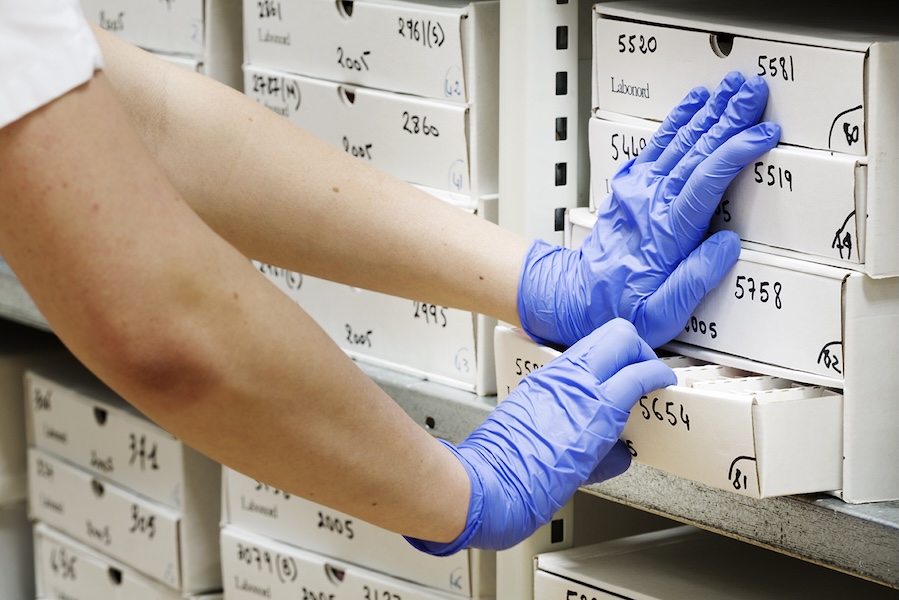
Many US pathology labs still manage archival blocks and slides in crowded on-site rooms, with cardboard boxes stacked on shelves and limited indexing.
This approach is difficult to reconcile with HIPAA and CAP expectations when biobanks must locate a single block tied to PHI within minutes and document how it moved.
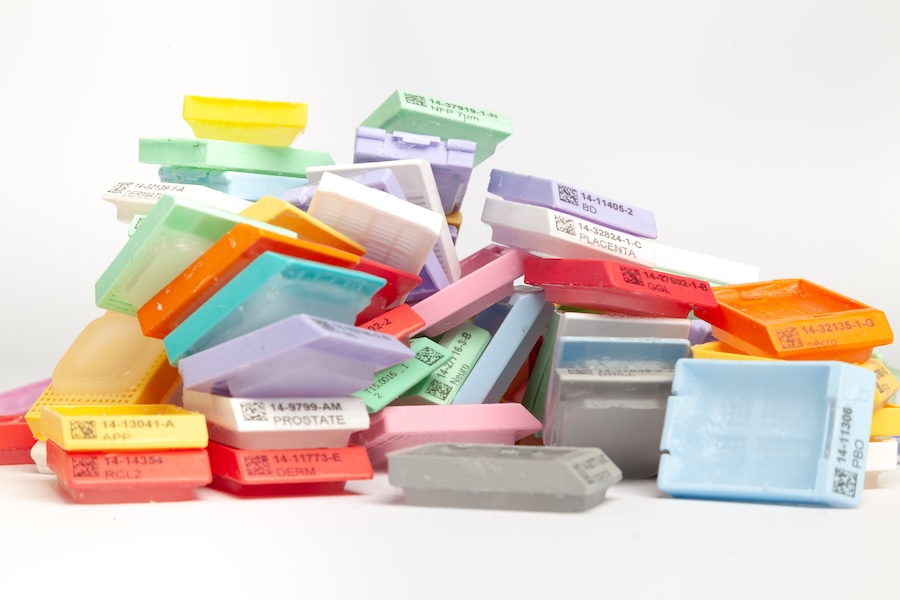
Best practice begins with standardizing containers, labeling, and racking so that every specimen has a precise physical address and a digital record.
We recommend mapping existing holdings, identifying high-risk untracked material, and migrating into structured trays and cabinets that support barcode-based retrieval.
Offsite archival should extend these controls, storing fully organized specimens in controlled environments with continuous tracking.
The result is a biobank that can prove custody, location, and integrity for each specimen at any point in time.
5. GPS Tracking, Chain of Custody, and Secure Transport for Biospecimens
HIPAA-compliant offsite storage for biobanks must treat transport as a controlled, auditable process, not a simple courier run.
We use GPS-tracked vehicles, sealed containers, and manifest-driven pickups so that every specimen leaving the lab is accounted for until it reaches its designated storage location.
Chain of custody records need to capture who prepared the shipment, who collected it, when it arrived, and where each container was filed.
This level of tracking helps biobanks defend against loss, misdelivery, or tampering allegations and supports litigation readiness.
For pathology labs, reliable transport also protects turnaround times for recuts and legal requests because specimens can be located and dispatched without delay.
When combined with standardized packaging and labeling, transport becomes a predictable, low-risk step in the biosample lifecycle.
6. Biobank Workflow Optimization: Short-Term vs Long-Term Storage
Efficient biobanks separate short-term, high-access storage from long-term archival so that pathologists and researchers can work without delays.
Short-term cabinets near the lab support active cases, research pulls, and recut requests, while long-term offsite storage preserves the bulk of the archive under tighter access controls.
We configure short-term environments with clear indexing and retrieval processes that mirror the offsite facility, so staff work within a consistent system.
Once specimens age beyond a defined threshold, they transition into offsite archival while retaining their same identifiers, barcodes, and tracking records.
This tiered approach reduces congestion in lab areas, lowers physical risk, and improves time to retrieval because staff always know which tier a specimen belongs to.
From a compliance perspective, it also clarifies who is responsible for each stage of the lifecycle and which controls apply.
7. Secure Packaging, Labeling, and Specimen Preservation
HIPAA-compliant offsite storage begins with the way biospecimens are packaged and labeled inside the lab.
We encourage biobanks to use durable, standardized packaging that protects specimens from crushing, moisture, and temperature fluctuations during handling and transit.
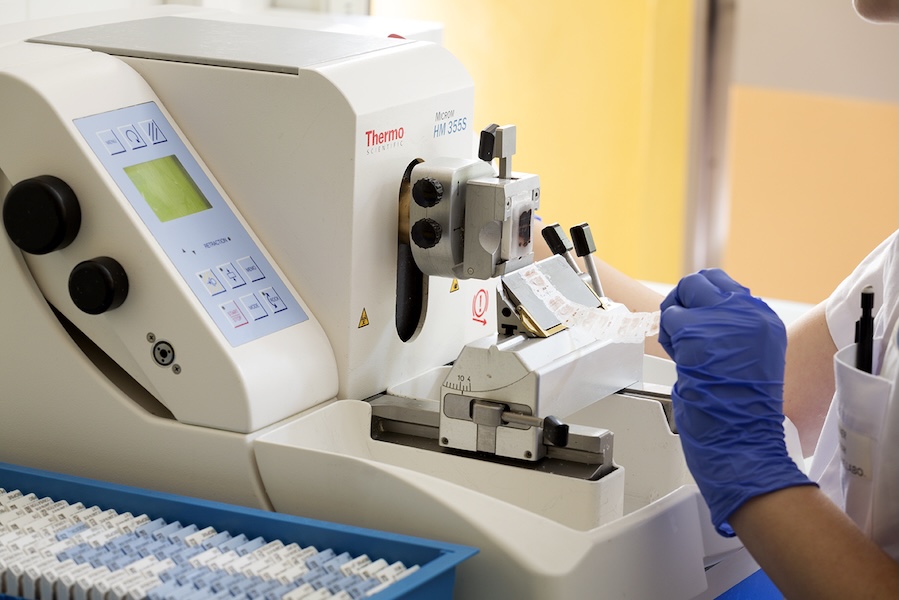
Labels must remain legible over many years, resist common solvents, and support barcodes or data matrix codes that map directly to the biobank’s inventory system.
To protect PHI, packaging should avoid unnecessary patient identifiers on external surfaces and rely on coded IDs whenever policies permit.
Offsite storage partners must then preserve these materials in environments that match or exceed institutional temperature and humidity requirements.
For paraffin blocks and glass slides, consistent room temperature conditions and dust protection are critical for long-term integrity and re-cut quality.
8. Digital Access, Scanning, and Inventory Systems for Biobanks
While biospecimens remain in secure offsite archives, researchers and clinicians still require rapid visibility into what is stored and how it can be retrieved.
Digital inventory systems provide that visibility through barcoded locations, audit trails, and role-based access, often integrated with institutional EMRs or research platforms.
Scan-on-demand services let biobanks request digital images or documents tied to a specimen, which are then delivered through encrypted channels rather than shipping the physical items.
This reduces transport risk, limits physical handling, and still respects HIPAA by applying encryption, authentication, and detailed logging for each access.
Many biobanks are aligning their practices with the 3-2-1 backup rule, maintaining multiple copies of digital inventories across on-premise and offsite systems.
By combining strong digital controls with physical security, biobanks can support both operational efficiency and regulatory expectations.
9. Vendor Selection: Questions to Ask an Offsite Storage Partner
Selecting a HIPAA-compliant offsite storage partner for a biobank is a governance decision, not a simple logistics contract.
We recommend that compliance, pathology leadership, IT security, and research administration all participate in vendor evaluation.
Key questions include how PHI is protected, whether the vendor signs BAAs, and how chain of custody is documented for every movement.
You should also ask about incident history, penetration testing, environmental monitoring, and disaster recovery capabilities.
Hybrid operations matter as well, so clarify how the vendor integrates with your existing inventory systems and retrieval workflows.
Site visits provide an opportunity to validate that written policies match real practices in the storage facility.
10. Audits, Retention Schedules, and Secure Destruction for Biobanks
HIPAA-compliant offsite storage for biobanks must support predictable, policy-driven retention and destruction, not indefinite accumulation.
Regular audits help identify specimens and records that have exceeded their mandated retention while ensuring that clinically or legally important materials remain protected.
We advocate for retention schedules that align CAP requirements, state law, and institutional policy, then drive automatic review cycles.
When destruction is appropriate, it should be performed in a certified, documented process that prevents recovery of PHI or biospecimen material.
Certificates of destruction and updated inventories provide defensible proof that the biobank followed its own policies.
Integrated storage, scanning, and destruction workflows reduce manual errors and preserve a clean, auditable chain of custody from accession to end of life.

Conclusion
HIPAA-compliant offsite storage for biobanks in 2026 requires more than shelving and temperature control, it demands a fully integrated system that protects specimens and PHI throughout their lifecycle.
By standardizing archival practices, enforcing chain of custody, leveraging digital access, and partnering with specialized storage providers, biobanks can reduce risk, support CAP and institutional requirements, and ensure that every biospecimen remains both accessible and secure for years to come.