In 2026, leading US biobanks and pathology labs routinely manage collections that exceed a million specimens, and platforms like Oracle’s Life Sciences AI Data Platform already unify more than 129 million de-identified longitudinal health records, so AI-enabled lifecycle management is no longer optional for tissue sample archiving and retrieval, it is mission critical.
Key Takeaways
| Question | Answer |
|---|---|
| How does AI improve tissue sample archiving and retrieval in 2026? | AI links every biosample to rich metadata, predicts optimal storage locations, and supports near-error-free retrieval for large archives, especially when combined with structured systems like our offsite tissue blocks and slides storage at CyteSafe. |
| What makes a biospecimen data platform HIPAA compliant in the US? | End-to-end encryption, granular access control, audit logs, and strong de-identification or limited data sets, backed by clear BAAs and lifecycle controls from accessioning to disposal. |
| How does AI support CAP standards for biobanking and pathology labs? | AI validates labeling, checks for missing data, flags pre-analytic issues, and maintains traceable histories that align with CAP Biorepository and Anatomic Pathology checklist expectations for specimen tracking and quality. |
| Can AI-enabled platforms work with offsite lab sample storage providers? | Yes, when offsite lab sample storage is integrated via secure APIs and scan-based workflows, AI can coordinate retrieval SLAs and maintain 100% chain-of-custody across locations. |
| What is required to optimize biosample storage workflows in 2026? | Structured physical storage, standardized barcoding, AI-ready metadata, and a central data platform that orchestrates requests, retrieval, and re-filing across onsite and offsite environments. |
| How can labs start modernizing their specimen lifecycle with external partners? | By combining internal LIMS / AP systems with dedicated archival partners and AI-enabled workflows, then engaging directly with specialists through secure channels such as CyteSafe’s contact team. |
1. Why AI-Enabled Biospecimen Lifecycle Management Is Non-Negotiable In 2026
Biospecimen collections in US hospitals, reference labs, and academic centers have reached a level of size and complexity that manual tracking can no longer safely support, particularly for long-term tissue sample archiving. AI-enabled lifecycle management brings computational discipline to accessioning, storage, retrieval, utilization, and final disposition, closing gaps that historically led to missing slides, misfiled blocks, or incomplete documentation.
Modern data platforms integrate histology, clinical, imaging, and consent data into a single longitudinal record per specimen, which is essential when a single patient’s tissue blocks and slides may underpin clinical care, clinical trials, and retrospective research over decades. In this setting, AI is not a novelty, it is the orchestrator of safe, compliant, cost-effective biosample storage across the full lifecycle.
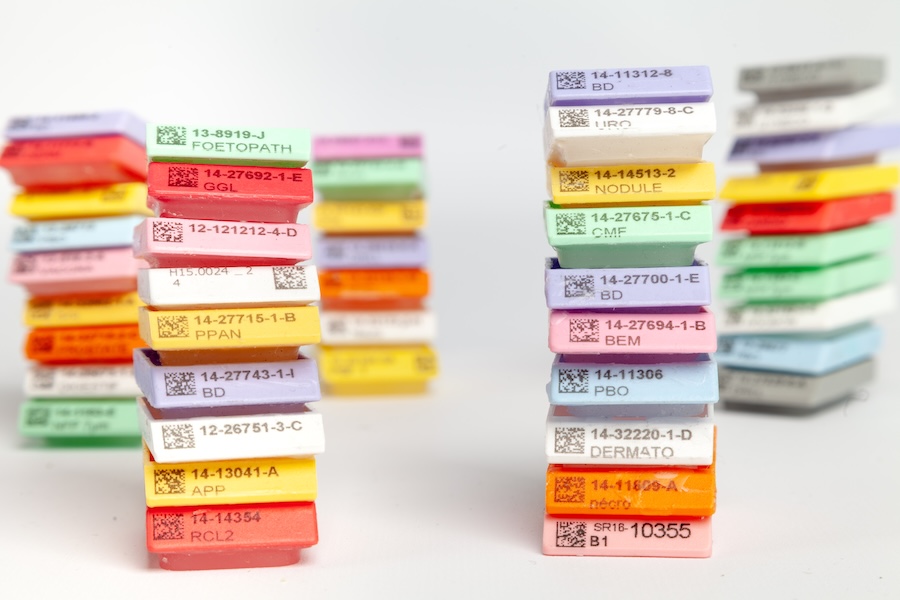
2. Core Principles Of AI-Ready Tissue Sample Archival And Retrieval
AI performs best when physical and digital worlds are tightly aligned, so tissue sample archiving must follow rigorous, repeatable structures that map cleanly into a biospecimen data platform. This includes standardized cassettes, slide labels, barcodes, and tray layouts that AI can interpret and validate at scale.
In 2026, leading US labs adopt several non-negotiable principles for AI-ready archival workflows:
- Every block and slide has a unique, machine-readable identifier tied to patient, specimen, and container metadata.
- Storage locations are encoded as structured coordinates rather than free text, which allows AI to reason about optimal placement and retrieval paths.
- Movements are captured in real time, often with double scanning, to keep the physical trail perfectly synchronized with digital records.

3. AI-Enabled Data Platforms: From LIMS Add-On To Central Nervous System
Traditional LIMS and AP systems were not designed to manage millions of longitudinally tracked biospecimens across clinical, translational, and commercial programs. In 2026, AI-enabled data platforms sit above or alongside these systems and act as the central nervous system for biospecimen lifecycle management.
They ingest structured data from pathology instruments, barcoding systems, storage robots, and offsite lab sample storage facilities, then use AI models to clean, reconcile, and link that data. This allows true end-to-end traceability from initial collection to long-term archival and eventual destruction or return, with a single audit-ready record per specimen.
Five-step AI-driven workflow for biospecimen lifecycle management. It shows how data platforms support each stage from collection to disposal.

4. Best Practices For HIPAA-Compliant Specimen Storage And Data Governance
HIPAA compliant specimen storage in 2026 extends beyond the physical environment into digital controls that cover the entire biospecimen data platform. We treat each tissue block, slide, and related dataset as part of a protected health information ecosystem that must remain secure and appropriately used throughout its lifecycle.
Key practices for US labs and biobanks include:
- Implement encryption at rest and in transit for all biospecimen data, including archival metadata and images.
- Use role-based access control with least-privilege assignments, and maintain detailed audit logs of every access and change.
- Adopt de-identification, pseudonymization, or limited data sets for research uses, supported by AI tools that continuously scan for residual identifiers.
- Ensure Business Associate Agreements are in place for any offsite biosample storage or cloud data services that handle PHI.

5. Meeting And Exceeding CAP Expectations With AI-Driven Workflows
CAP accreditation in 2026 increasingly expects robust specimen traceability, error reduction, and documented quality metrics, all of which are strengthened by AI-enabled lifecycle management. CAP-accredited biobanks and labs in the US use AI to monitor pre-analytical, analytical, and post-analytical quality indicators and to provide objective evidence of control.
At the practical level, AI can:
- Detect label mismatches between requisitions, slides, and blocks before they reach pathologists.
- Track storage durations and conditions to ensure compliance with CAP and institutional retention policies.
- Support proficiency testing and internal audits by rapidly identifying representative specimens and associated documentation.
We design our offsite biosample storage and data linkages so that labs can maintain CAP-compliant oversight even when specimens reside in external facilities, with clear chain-of-custody and retrieval performance metrics.

6. Secure And Efficient Offsite Lab Sample Storage In An AI-Orchestrated World
Offsite lab sample storage in 2026 must integrate tightly with AI-enabled data platforms to behave as an extension of the primary lab rather than a separate island. Our role is to provide risk-proof biosample storage and retrieval, while ensuring that every movement is captured digitally so AI can optimize where specimens live and how they are retrieved.
Best practices for AI-compatible offsite storage include:
- Standardized, barcoded containers and cartons that map directly to digital storage locations.
- Double scanning at pickup and receipt to validate contents and update the central platform in real time.
- GPS-tracked logistics combined with automated notifications to LIMS and data platforms as specimens move.
When a pathologist or researcher requests a block or slide, AI can prioritize urgency, batch compatible requests, and select the most efficient retrieval path, while we execute the physical retrieval with guaranteed accountability.
7. Tissue Blocks And Slides Storage: Physical Design For Digital Precision
Physical storage design is a foundational enabler for AI-enabled tissue blocks and slides storage. If blocks are stacked irregularly or slides are filed without a standard schema, even the most advanced AI cannot reliably predict or validate locations.
We advocate for and implement:
- Tray-based systems with fixed capacity and clear row-column coordinates that map one-to-one into digital schemas.
- Segregation by specimen type, retention class, or study, which AI can then use as features when predicting retrieval patterns or optimizing layout.
- High-density, climate-controlled environments that protect specimens while keeping them logically accessible for humans and machines.
With this approach, AI can provide confident answers to a simple but crucial question for every request in 2026: “Is the correct sample, in the correct condition, at the expected location right now?”


8. AI For Workflow Optimization In Busy US Pathology Labs
In 2026, US pathology labs face sustained pressure on turnaround times, staffing, and cost per case. AI-enabled biospecimen lifecycle management directly supports workflow optimization by reducing non-value-added search, rework, and manual reconciliation around tissue blocks and slides.
Examples of AI-driven efficiencies include:
- Predictive retrieval, where AI anticipates which archival blocks may be needed for add-on stains, molecular tests, or tumor boards and prepositions them.
- Automated routing of retrieval requests to onsite or offsite storage based on priority, location, and courier schedules.
- Real-time dashboards that show pending, in-progress, and completed retrievals, along with aging metrics and bottleneck alerts.
By pairing these capabilities with our disciplined specimen logistics, labs can assure that pathologists always receive the correct material without delays or ambiguous status updates.
9. Future-Proofing Biobanking Technology With AI And Synthetic Data
Biobanking technology in 2026 increasingly converges with advanced analytics, including synthetic data generation that allows safe modeling of patient cohorts and specimen utilization without exposing real identities. AI-enabled platforms can simulate demand on tissue archives, predict storage growth, and stress-test retrieval capacity.
Forward-looking US institutions are also:
- Using AI to score specimens for potential research value, aligning consent status, molecular profiling, and clinical outcomes.
- Integrating organoid and other advanced models into the same lifecycle frameworks as traditional tissue blocks.
- Connecting biobank inventories with national and multi-institutional networks that respect HIPAA and CAP constraints while enabling faster discovery.
Our responsibility is to ensure that the underlying biosample storage, tracking, and access controls remain rock solid as these innovative applications expand.
10. Practical Steps For US Labs To Implement AI-Enabled Biospecimen Platforms In 2026
For many US labs, the question in 2026 is not whether to adopt AI-enabled lifecycle management but how to start without disrupting critical operations. We recommend a phased, low-risk approach that focuses on specimen safety and staff confidence.
- Assess current archival practices. Map how tissue blocks and slides are labeled, stored, and retrieved today, and identify error points or delays.
- Standardize identifiers. Move toward universal, machine-readable labels that link directly into your LIMS and future data platform.
- Partner with experienced offsite storage providers. Shift older or lower-velocity material into structured, AI-compatible biosample storage while keeping high-use material nearby.
- Select or upgrade your central data platform. Ensure it can integrate with logistics providers, barcoding systems, and analytics tools.
- Introduce AI incrementally. Start with validation and alerting, then progress to predictive retrieval and capacity planning.
Throughout this process, we work side by side with laboratory and compliance leaders to maintain full HIPAA and CAP alignment while steadily improving operational performance.
Conclusion
AI-enabled lifecycle management and data platforms for biospecimens have become foundational to safe, efficient, and compliant pathology and biobanking operations in the United States in 2026. When AI-ready data platforms are combined with disciplined tissue sample archiving, secure offsite lab sample storage, and strict adherence to HIPAA and CAP standards, laboratories gain 100 percent accountability for every tissue block and slide in their care.
Our focus is to provide the physical security, tracking precision, and workflow reliability that allow AI systems to operate with confidence, so clinical teams and researchers always receive the correct specimen at the right time. As collections grow and analytical methods advance, this partnership between robust biosample storage and intelligent data platforms will define the next decade of pathology and biobanking excellence.