
In 2026, US pathology labs and biobanks are under pressure to prove exactly where every tissue block, slide, and biosample is at all times, and one recent pilot tracked 1,812 personal biospecimens digitally across multiple research protocols, showing how fast real-time traceability is becoming the new standard.
RFID and smart label technologies now sit at the center of best practices for tissue sample archiving, retrieval, and complete biosample lifecycle management, especially for labs that must remain HIPAA and CAP compliant while controlling risk and cost.
Key Takeaways
| Question | Answer |
|---|---|
| 1. How do RFID and smart labels improve biospecimen tracking? | They give every specimen a unique, machine-readable identity, allowing real-time location, chain-of-custody history, and instant verification from accessioning through long-term biosample storage. |
| 2. Are RFID-based systems compatible with HIPAA and CAP in 2026? | Yes, when designed correctly they support HIPAA compliant specimen storage and CAP expectations by enforcing access controls, audit trails, and specimen-level traceability, as promoted by US providers like CyteSafe. |
| 3. What is the impact on tissue sample archiving and retrieval times? | Smart labels can cut retrieval time for tissue blocks and slides storage from hours to minutes, because staff search by verified IDs and precise locations instead of manual box-level indexing. |
| 4. Can RFID support offsite lab sample storage and transport? | Yes, many US archives pair RFID with GPS-tracked transport and handheld PDAs, enabling validated handoffs and full visibility during offsite lab sample storage transfers, a core feature of services like CyteSafe Premium Storage. |
| 5. What standards should US labs consider in 2026? | Labs should align RFID and smart label systems with CAP Biorepository Accreditation requirements, HIPAA security rules, and global labeling standards such as ISO 20070:2025 for biobanking containers. |
| 6. How do I start a real-time tracking project for tissue archives? | Begin with a detailed audit of your current tissue sample archiving process, then engage a specialist provider through channels like CyteSafe’s contact team to design a hybrid barcode/RFID and software workflow. |
1. Why Real-Time Tracking of Biospecimens Is Non‑Negotiable in 2026
In 2026, US labs carry growing medico-legal, financial, and reputational risk if they cannot prove where a specific tissue block or slide has been, who touched it, and when.
At the same time, underutilization remains a major concern, with an estimated 67% of biobanks reporting that samples are not used to their full potential, which makes precise traceability and retrieval a core value driver, not just a compliance checkbox.
Rising expectations from regulators, clinicians, and patients
CAP, HIPAA, and hospital quality programs now expect specimen-level chain-of-custody, not just box-level documentation.
Patients and research participants also expect transparent governance, especially as pilots in 2025 and 2026 have shown that thousands of personal biospecimens can be actively tracked and linked to their owners through digital tools.
From passive storage to active biosample lifecycle management
Real-time tracking enables a full biosample lifecycle lens, from collection and diagnostic use to research, retention, and secure destruction.
We see US labs increasingly segmenting storage policies by age and clinical value of materials, and they rely on smart identifiers to automate those lifecycle rules.
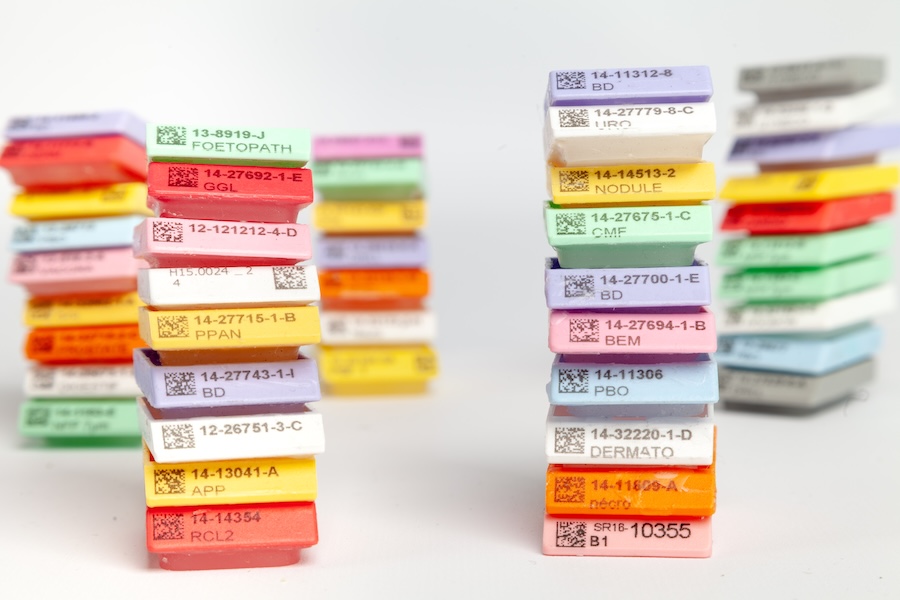
2. How RFID and Smart Labels Work for Tissue Blocks and Slides
RFID and smart labels give each specimen a durable, machine-readable identity that can be scanned without line of sight, even when blocks and slides are inside trays or archival boxes.
In 2026, most US labs pair RFID tags with human-readable identifiers and barcodes, which keeps workflows resilient if readers fail while still enabling high-speed, bulk scanning.
Key components of a smart labeling ecosystem
A modern system combines several building blocks.
- Unique ID printed and encoded on every cassette and slide.
- RFID inlays or smart labels on trays, racks, and boxes for hierarchical tracking.
- Handheld PDAs and fixed readers at key workflow points like grossing, embedding, and archive intake.
- Middleware or a laboratory information system that records every movement, timestamp, and user ID.
Why this matters for specimen integrity
Mislabeling and misfiling are among the highest-risk failure points in tissue sample archiving.
By automating identification, smart labels reduce transcription errors, support positive patient identification, and preserve the integrity of the diagnostic narrative connected to each specimen.
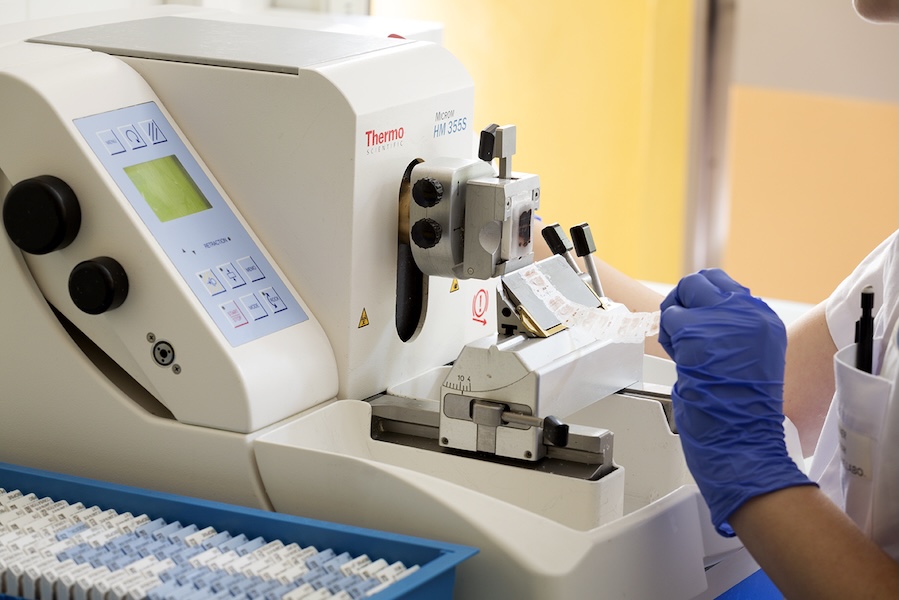
3. Best Practices for Smart Label Design in Tissue Sample Archiving
Label design is a foundational decision for any RFID or smart label program in 2026, because it directly affects read performance, patient safety, and longevity in harsh histology environments.
For US labs, we recommend designing labels with explicit alignment to CAP checklists and ISO 20070:2025, which focuses on labeling and traceability requirements for primary containers in biobanking.
Content and formatting on each label
Every label that touches a biospecimen should carry consistent, unambiguous data.
- Primary identifier, such as a specimen or case ID.
- Accession number and part/block designation.
- Human-readable patient identifier formats that respect HIPAA de-identification when appropriate.
- Barcode and, where needed, RFID encoded ID mapped to the same master record.
Durability considerations for tissue blocks and slides storage
Archival labels must survive solvents, staining processes, and multi-decade ambient storage.
In 2026, many labs choose polymer or laminated smart labels with chemical resistance, then validate that RFID inlays remain readable after processing and during long-term biosample storage.
This infographic highlights five key benefits of RFID/Smart labels for real-time biospecimen tracking. It explains how these technologies improve sample traceability, workflow efficiency, and data accuracy.
4. Integrating RFID With Real-Time Tracking Systems in US Labs
RFID alone does not deliver real-time visibility; the value emerges when tags are tightly integrated with software that records each movement and exposes that history in a usable way.
In 2026, US labs are converging on architectures that link RFID readers, PDAs, and GPS-tracked logistics with centralized specimen management platforms.
Key workflow points for real-time scanning
To achieve a complete chain-of-custody, we recommend scanning at all major transition points.
- Specimen receipt and accessioning.
- Grossing, embedding, and cutting for blocks and slides.
- Placement into trays and archival boxes for long-term tissue sample archiving.
- Outbound retrieval, shipping, and return for consults or research.
Using PDAs and GPS tracking for offsite lab sample storage
Services like CyteSafe explicitly incorporate PDAs for specimen movement and GPS tracking of transport vehicles.
This combination allows labs to see, in real time, when a specific archived block left their facility, where it is en route, and when it is validated into secure, alarmed storage.

5. Real-Time Tracking and Biosample Lifecycle Management
RFID and smart labels support lifecycle-based decisions that are now central to responsible biosample storage in 2026.
Instead of treating all blocks and slides as equal, labs use time stamps and usage histories to prioritize what must remain accessible onsite, what can move to offsite lab sample storage, and what is eligible for secure destruction.
Lifecycle stages for tissue blocks and slides
A mature lifecycle model typically includes four stages.
- Acute diagnostic phase: High retrieval frequency, usually onsite cabinets.
- Clinical follow-up window: Medium frequency, potentially near-site or hybrid storage.
- Long-term archival: Low frequency, ideal for highly organized offsite tissue blocks and slides storage.
- End-of-life / destruction: Documented, policy-based disposal with tracking of every destroyed item.
Using data to reduce underutilization
Real-time tracking data reveals which collections are heavily requested and which remain dormant.
This allows pathology and research leaders to re-prioritize curation, consent refresh, or de-identification projects that can ethically increase the use of stored biospecimens in research while preserving privacy and compliance.

6. HIPAA-Compliant Specimen Storage and CAP-Ready Tracking
HIPAA and CAP do not mandate specific technologies such as RFID, but they do require rigorous safeguards that smart labels and real-time tracking support very effectively.
In 2026, US labs pursuing or maintaining CAP Biorepository Accreditation need a defensible, auditable trail for every biospecimen, and RFID-enhanced systems are one of the most efficient ways to achieve this.
HIPAA considerations for RFID and smart labels
Protected health information must be handled carefully at the label and system levels.
- Limit PHI printed on labels that may leave controlled environments.
- Encrypt or pseudonymize IDs stored in RFID chips when risk assessments warrant it.
- Restrict RFID and database access to authorized staff with role-based controls and logging.
CAP expectations for chain-of-custody
The CAP Biorepository Accreditation Program emphasizes traceability from collection through processing, storage, and distribution.
RFID systems make it far easier to satisfy these expectations by documenting every accession, storage move, retrieval, shipment, and destruction event with time, location, and user identity.
7. Tissue Specimen Security: From Cabinets to Alarmed Offsite Archives
Security in 2026 extends beyond locks on doors; it now includes digital controls, environment monitoring, and transport validation from the lab to external archives.
Providers such as CyteSafe focus on alarmed and secure archives with ambient environmental controls, exterior cameras, trained staff, and total chain-of-custody tracking.
Onsite versus offsite security profiles
Onsite short-term cabinets are ideal for rapid access but often rely on local physical security and lab protocols.
Offsite facilities can layer multiple security controls, including monitored access points, redundant alarm systems, and centralized camera coverage that is dedicated to specimen protection.
Risk mitigation during transport
The gap between lab and archive is one of the most vulnerable phases for a specimen.
Pairing RFID-tagged containers with GPS-tracked vehicles and PDA-based validation at pickup and drop-off ensures that no biospecimen is unaccounted for, even for high-volume shipments of blocks and slides.
8. Workflow Optimization in Pathology Labs Using RFID
RFID and smart labels are powerful tools to reshape daily workflows in US pathology labs, particularly those struggling with overflowing archives and manual retrieval processes in 2026.
By organizing tissue blocks and slides into structured, labeled units that can be scanned in bulk, labs reduce manual search time, overtime, and the risk of misplacement.
Typical time savings and process improvements
Based on our observations, labs that implement RFID-guided archives often report dramatic improvements.
- Retrieval of a single historic block falls from 30–60 minutes to less than 5 minutes.
- End-of-day reconciliation moves from paper sign-out sheets to automated reports.
- Annual archive audits become targeted exception checks rather than full physical counts.
Standard operating procedures for RFID-enabled archives
Optimized workflows rely on clear, written procedures.
We recommend explicit SOPs covering intake labeling, tray and box assignment, scanning protocols, exception handling, and escalation paths when discrepancies are found by the tracking system.
9. Offsite Lab Sample Storage: Extending Real-Time Visibility Beyond the Lab
For many US hospitals and reference labs in 2026, offsite lab sample storage is no longer optional; space constraints and risk management imperatives make external archives the most sustainable strategy.
The challenge is to extend real-time visibility from the LIS and onsite cabinets to those remote archives without losing control.
How RFID supports seamless offsite workflows
We see leading labs using RFID-enabled cartons and trays to make offsite logistics as transparent as onsite movement.
- Cartons are labeled with smart identifiers linked to detailed contents lists.
- Pickup events are scanned and validated in the lab and again at the offsite dock.
- Requests for specific blocks or slides trigger guided retrieval in the offsite facility, with each scan fed back to the lab in real time.
Comparing onsite and offsite options
While we cannot include specific pricing here, labs typically evaluate costs across several dimensions.
| Factor | Onsite Archive | Offsite RFID-Tracked Archive |
|---|---|---|
| Capital footprint | High, especially for growing collections | Lower onsite footprint, cost per specimen predictable |
| Access speed | Fast for current cases, slower for deep archives | Fast with structured retrieval SLAs and RFID-guided searching |
| Security controls | Dependent on hospital infrastructure | Dedicated, alarmed facilities with continuous monitoring |
10. Roadmap for Implementing RFID and Smart Labels in 2026
Implementing RFID/Smart labels and real-time tracking for biospecimens is a staged process that requires technical, operational, and governance alignment.
In 2026, the most successful US programs follow a structured roadmap rather than a rapid, all-at-once rollout.
Stepwise approach for pathology and biobank leaders
We recommend a phased progression that reduces risk and builds confidence.
- Assessment: Map current tissue sample archiving processes, pain points, and compliance gaps.
- Pilot: Start RFID on a defined subset, for example new surgical pathology blocks, to refine labels and workflows.
- Integration: Connect readers and databases to your LIS or biobank software, ensuring accurate bidirectional data flow.
- Scale: Extend to legacy archives and offsite lab sample storage as SOPs, staff training, and performance metrics stabilize.
Partnering with specialized US providers
Given the stakes for patient care and litigation risk, many laboratories choose to partner with dedicated biospecimen management providers.
At CyteSafe, we specialize in risk-proof biosample storage and retrieval, with advanced tracking systems, GPS-tracked logistics, and CAP-compliant storage environments that integrate smoothly with RFID and smart label strategies.
Conclusion
In 2026, RFID and smart labels are no longer experimental in US pathology and biobanking; they are becoming core infrastructure for accountable, efficient, and compliant biospecimen management.
By combining durable smart labels, real-time tracking software, GPS-tracked logistics, and CAP- and HIPAA-aligned governance, laboratories can protect patients, reduce litigation risk, and ensure that every tissue block and slide remains findable, usable, and secure throughout its lifecycle.