
In 2025 alone, over 3,700 laboratories worldwide participated in the International Freezer Challenge, saving about 31.5 million kWh of energy and avoiding roughly 21,000 metric tons of CO2, which shows just how critical disciplined biosample storage and archival solutions have become for modern labs.
In the United States, pathology and clinical laboratories are under growing pressure to preserve more tissue samples for longer periods while maintaining strict compliance, traceability, and rapid retrieval for patient care and research.
Key Takeaways
| Question | Concise Answer |
|---|---|
| What are biosample storage & archival solutions? | Integrated systems, facilities, and processes that preserve tissue blocks, slides, and other specimens under controlled conditions with full chain-of-custody and retrieval visibility, both onsite and offsite. |
| Why should US labs consider dedicated offsite tissue archives? | To reduce on-site congestion, improve disaster resilience, and ensure long-term compliance with CAP and HIPAA, while maintaining fast retrieval and accountability, as offered by providers like CyteSafe. |
| How does better archival management reduce litigation risk? | By providing validated chain-of-custody, accurate refiling, and complete history for each sample, which supports defensible documentation and higher confidence in patient care decisions. |
| What role does biosample lifecycle management play in 2026 workflows? | Lifecycle management connects accessioning, storage, retrieval, re-filing, and final disposition under a single tracking framework, improving throughput and minimizing lost or misfiled specimens in busy US pathology labs. |
| How can labs balance energy use with sample integrity? | By adopting energy-aware temperature strategies, efficient storage layouts, and modern ULT equipment, while still meeting stability requirements for specific biosample types over the full archival period. |
| What is the most important feature of an archival solution? | Reliable tracking and retrieval, so that the correct block or slide can be located, validated, and delivered under strict chain-of-custody controls whenever the clinical team or researcher needs it. |
1. Why Biosample Storage & Archival Solutions Matter More Than Ever in 2026
US laboratories now manage millions of biosamples across tissue blocks, slides, and related materials, often under retention requirements that stretch 10 years or more.
At the same time, high-profile freezer failures have destroyed tens of thousands of samples in single incidents, highlighting the cost of fragmented or poorly governed archival systems.
The typical ultra-low temperature freezer can consume up to 20 kWh per day, so unmanaged fleets quickly become both a financial and operational burden.
For many laboratories, the question is no longer whether to modernize archival systems, but how to do it without disrupting patient care or research.
Effective biosample storage and archival solutions must provide:
- Stable, validated environments aligned with specimen type.
- Full visibility of location and status for every sample.
- Secure, compliant handling from lab bench to archive and back.
- Rapid retrieval that supports clinical turnaround times.
We see more pathology groups, health systems, and research organizations turning to specialized partners to help them regain control of their archives.

2. Core Principles of Modern Biosample Storage and Archival
A robust archival solution starts with clear principles that apply regardless of lab size or subspecialty.
We design storage programs around five pillars that directly support pathologists and compliance officers.
- Integrity: Maintaining sample quality over time through validated environmental controls, proper packaging, and handling.
- Traceability: Recording every movement and interaction in a single tracking system with timestamps and user credentials.
- Accessibility: Ensuring staff can request and receive the correct specimen quickly, whether it is stored onsite or offsite.
- Security: Protecting biosamples and associated data through physical safeguards, restricted access, and encryption.
- Compliance: Aligning retention, privacy, and quality practices with CAP, CLIA, HIPAA, and state regulations.
In practice, this means that every block and slide moves through a defined chain-of-custody from the lab to the archival facility and back again.
Each location change is scanned, validated, and reconciled so there is no ambiguity about where a specimen is or who last handled it.
3. Best Practices for Tissue Sample Archival and Retrieval in US Pathology Labs
Effective archival begins at the moment a block or slide is created, not when boxes start to overwhelm the back room.
By standardizing intake and retrieval practices, labs can avoid the costly cycle of emergency reorganizations and reactive searching.
Standardizing Intake and Labeling
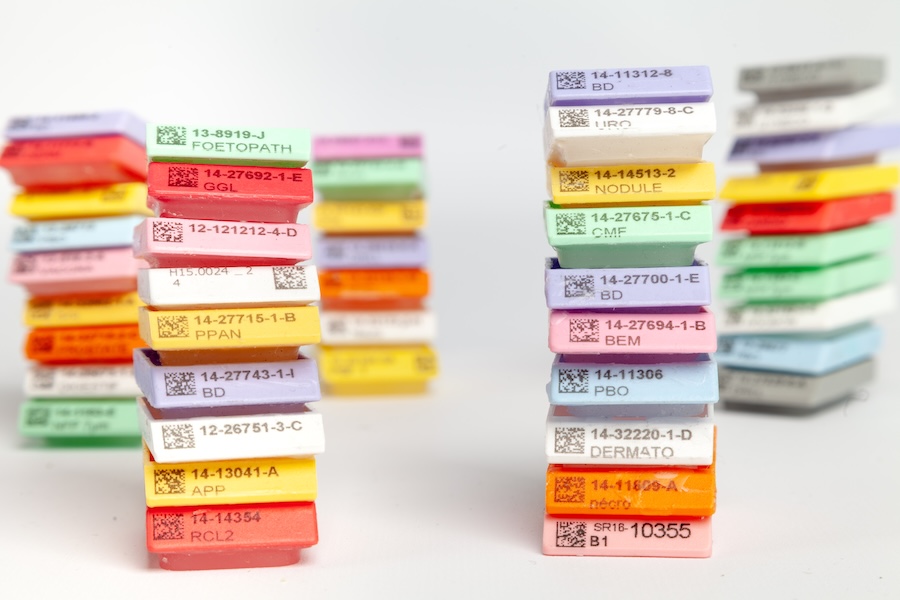
We recommend that every specimen is labeled with a consistent, machine-readable identifier that connects to the LIS and the archival tracking system.
This identifier should remain the single source of truth across onsite and offsite locations, including any temporary transfer states.
Structured Storage and Refilling
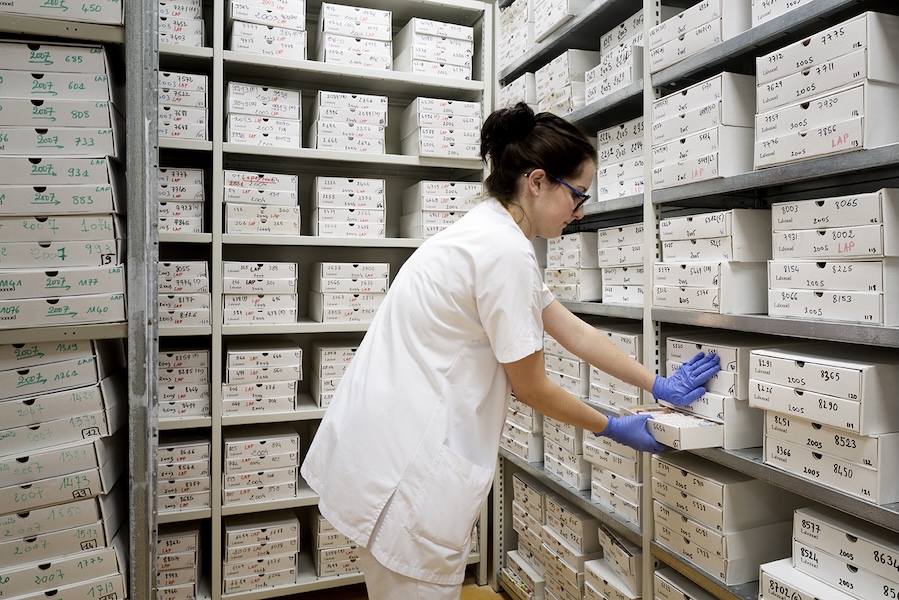
Instead of stacking mixed boxes on shelves, we favor structured storage layouts with defined positions, ranges, and tray systems.
Automated or semi-automated tray solutions reduce misfiles, shorten retrieval time, and support accurate auditing of stored material.
Retrieval Workflows that Support Patient Care
For US labs, the ability to retrieve a block or slide within defined service windows is crucial for tumor boards, consults, and clinical trials.
We implement service level agreements for retrieval and delivery, supported by GPS-tracked couriers and digital confirmation at each handoff.
This infographic highlights three key benefits of biosample storage and archival solutions for labs. It helps researchers compare options for preservation and access.

4. Biosample Lifecycle Management: From Accessioning to Final Disposition
Biosample lifecycle management connects all stages of a specimen’s journey into a single, auditable framework.
In 2026, this is no longer a theoretical concept but a practical requirement for large US labs.
Key Stages in the Biosample Lifecycle
- Accessioning: Assigning identifiers and recording clinical context.
- Processing: Embedding, cutting, and staining, with appropriate labeling.
- Short-term storage: High-access cabinets for active cases and consults.
- Archival storage: Long-term, structured environments, often offsite.
- Retrieval and use: Diagnostic review, research, litigation, or quality checks.
- Disposition: Documented destruction or transfer at end of retention.
At each step, the same core identifier follows the specimen, and the archive system records all transitions.
This not only improves operational control, it also supports CAP inspections and internal quality audits.
Aligning Lifecycle Management With US Regulations
We work with clients to map retention timelines and storage modalities to applicable standards.
For example, histology blocks and slides can have different minimum retention periods, and some states layer additional requirements on top of CAP.
5. HIPAA and CAP Compliance in Biosample Storage: What US Labs Must Demonstrate
Compliance is not only about having policies, it is about demonstrating that those policies are consistently followed across the biosample lifecycle.
In 2026, regulators and accrediting bodies expect clear evidence of both physical and digital controls for biosample archives.
HIPAA Considerations for Biosample Archives
Under HIPAA, protected health information must remain confidential and secure wherever it resides.
For tissue archives, this includes labeled slides, request logs, and any electronic systems that store identifiers or clinical context.
We support HIPAA alignment through:
- Restricted access to storage areas and tracking systems based on role.
- Audit trails for every retrieval and return.
- Encrypted communication for digital requests and confirmations.
CAP and Quality Management Expectations
CAP inspectors now routinely review how archives are organized, tracked, and audited.
They may ask to see specific blocks and slides, review chain-of-custody logs, and confirm that retention policies match actual practice.
Our archival solutions are built to:
- Demonstrate full traceability for selected specimens.
- Show environmental monitoring and incident response documentation.
- Provide evidence of regular internal audits and reconciliation checks.
6. Energy-Efficient Biobanking and Sustainable Archival Strategies
Energy use is now a central topic in discussions about long-term biosample storage across US institutions.
With each ULT freezer consuming up to 20 kWh per day, unmanaged inventories can easily consume as much electricity as a small building.
Optimizing Temperature and Equipment
Many sample types remain stable at higher ultra-low temperatures than the legacy default of −80°C.
Raising setpoints where scientifically appropriate can generate significant savings without compromising integrity.
Strategic consolidation of underutilized freezers and adoption of ENERGY STAR rated models provide additional benefits.
For new or expanding archives, we encourage facilities teams to model life-cycle costs and carbon impact along with up-front capital.
Integrating Sustainability Into Archival Planning
Sustainability should be woven into archive design, not treated as an afterthought.
This includes efficient spatial layouts, appropriate use of ambient or refrigerated storage for suitable samples, and robust maintenance programs to prevent failures.
7. Innovations in Biobanking Technology: Tracking, Automation, and Analytics
Innovations in biobanking technology have changed what is possible for tissue archives in the United States.
Where spreadsheets and manual logs once dominated, dedicated software and automated handling now enable nuanced control at scale.
Advanced Tracking and Chain-of-Custody
Modern archival systems rely on barcode or RFID tracking linked directly to specialized software.
Every scan creates an immutable event, whether it is intake, relocation within a tray, retrieval, or re-filing.
We work closely with software providers that emphasize reliable retrieval logic.
When a technologist searches for a case, the system returns a precise storage location rather than a range or shelf.
Automation and Smart Storage Infrastructure
Automated tray movements, guided pick lists, and route optimization are increasingly common in high-volume archives.
These technologies help reduce errors, shorten time-to-retrieval, and protect staff from repetitive manual handling.
Over time, archival analytics can reveal utilization patterns such as which blocks are frequently recalled or which ranges see little activity.
Labs can use these insights to refine storage tiers, separating high-access and deep archival materials more effectively.
8. Tissue Specimen Security and Risk Management
Secure biosample storage is about more than locked doors, it is about preventing both physical and informational loss across the entire chain.
High-profile incidents, including large-scale cryogenic failures abroad, have reinforced the need for proactive risk management.
Physical and Environmental Security
We design archival facilities with access control, surveillance, and documented visitor management.
Critical storage zones maintain monitored environmental conditions with alarms and defined escalation paths.
Backup power, temperature redundancy, and tested incident response plans are essential for risk reduction.
We encourage clients to review how long their archives can remain within safe ranges during outages and how they will prioritize recovery actions.
Data Security and Privacy
Archival tracking systems must protect linkages between specimen identifiers and patient information.
We support this through role-based access, audit logs, and secure integrations with LIS or data warehouses.
Regular risk assessments help confirm that both physical and digital safeguards remain aligned with evolving threats and regulations.
This level of diligence supports both HIPAA compliance and broader institutional governance expectations.
9. Onsite vs Offsite Biosample Storage: Choosing the Right Model
Most US labs now operate in a hybrid environment that combines onsite and offsite biosample storage.
The right balance depends on case volume, campus layout, staffing, and institutional risk tolerance.
When Onsite Storage Makes Sense
Onsite archives work well for:
- Short-term storage of high-access specimens.
- Small to medium archives within a single facility.
- Institutions with strong internal facilities and security resources.
Short-term cabinets and compact tray systems near the lab can support rapid repeat cuts or re-reviews.
However, as volume increases, onsite archives often strain space and staffing.
Advantages of Dedicated Offsite Archival Facilities
Offsite solutions, such as those offered by us, relieve pressure on clinical spaces while maintaining full control of specimens.
We track every box, tray, block, and slide with validated chain-of-custody, supported by GPS-tracked pickups and deliveries.
This model provides:
- Reduced on-site congestion and fire load.
- Professional archival environments purpose-built for tissue preservation.
- 24/7 monitoring and incident response dedicated to the archive.
We collaborate with each client to define which specimens remain onsite and which move to offsite storage, often in phased programs.
10. Workflow Optimization for Pathology Labs: Turning Archives Into Reliable Infrastructure
A well-designed biosample archive should feel like a dependable extension of the laboratory, not a separate, opaque system.
Our goal is to help labs experience archival services as reliable, predictable infrastructure.
Designing Workflows Around Real-world Use
We start by mapping how pathologists, histotechnologists, oncology teams, and researchers actually interact with biosamples.
From there, we design request paths, approval logic, and delivery windows that match those needs.
To reduce friction, we support:
- Electronic request portals that connect directly to tracking systems.
- Automated notifications at each step of retrieval and transit.
- Clear cut-off times and rapid options for urgent cases.
Training, Change Management, and Continuous Improvement
Even the best-designed archival solution depends on consistent user practices.
We provide training, documentation, and support during go-live and beyond.
Regular review of retrieval metrics, misfile incidents, and turnaround times helps us adjust layouts and processes.
Over time, this creates a cycle of continuous improvement that supports both efficiency and quality.
Conclusion
In 2026, biosample storage and archival solutions have become a strategic capability for US pathology labs, not just a backroom task.
With growing volumes, stricter regulations, and rising expectations from clinicians and researchers, archives must deliver reliability, traceability, and secure access at scale.
We help laboratories re-take control of their tissue blocks and slides through structured storage, validated chain-of-custody, and modern biobanking technologies.
From intake and lifecycle management to offsite archival, retrieval, and risk mitigation, our focus is to protect every specimen while supporting the workflows that depend on it.
For laboratories evaluating next steps in modernizing their biosample storage and archival strategies, a conversation about real-world constraints, compliance needs, and growth plans is the right place to begin.
Together, we can design archival solutions that protect your specimens, support your teams, and stand up to the demands of 2026 and beyond.